Tuesday, December 11, 2012

What next?


The morning after we arrived in Urupukapuka, we piled into Tuerto and motored just over a mile across the channel to the mainland, landing on a beach at a town called Rawiki ('w' pronounced 'v') and joking that that had been our most dangerous crossing, though Tuerto was doing well since his latest patch and only suffered a few slow leaks. We pulled the dinghy up, tied the painter to a tree and walked up to the road. There were a few houses lining the road at the base of the small cove, but nothing stirred. Up the street, we saw a man with a hard-hat walk past a fence toward a house with scaffolding on the front. We walked up and asked one of the construction workers if he knew where to find the trail to Cape Brett. He said, “Oh,” and got slowly up from kneeling. He walked towards us wiping his gloved hands together contemplatively and we all had the feeling he was about to describe whatever long, winding journey to the trail-head to which we had subjected ourselves.

Our boats anchored off the beach at center-right.

“Well,” he pointed along the road to our right, “you walk up the road that way about fifty-yards and there's some stairs. That's the start of the trail.”

“Oh, alright, guess we should have explored a bit more. Thanks. Take 'er easy.”

“Sure thing.”

The Kleemans along the path.
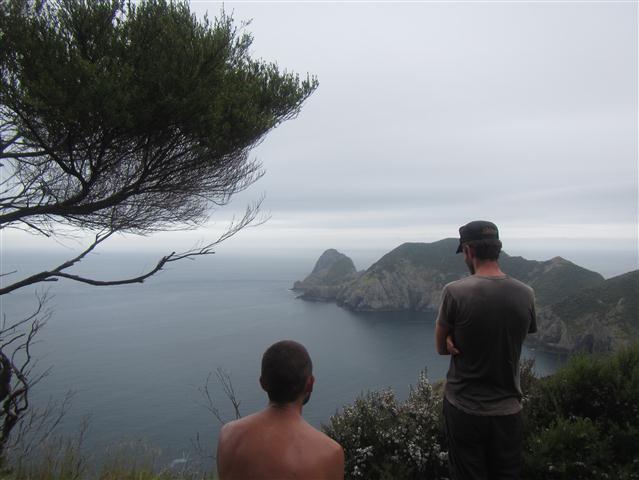
At the base of the stairs I sat down and put my boots on. It had been a long time since I had worn my hiking boots and wool socks with them, but in a few hours, I would be very glad to have them. The trail on which we set out was immediately challenging. We had estimated from a map that it was about 10 km each way to Cape Brett, which forms the southern limit of Bay of Islands. We weren't too far off, though it ended up coming out to about 16 km each way. The real kicker, though, was the elevation changes. The ridge that formed the Cape was long and vertically winding. We all quickly realized what sort of physical condition we were in. It wasn't so much the cardiovascular aspect of things, but the climbs. Oh, there were many steep climbs. The most heart-breaking part was knowing that it would be no less demanding on the return trip. Nevertheless, we pushed on and made it to the furthest peak. We could have followed the trail down toward the water where there was apparently a DOC cabin, but we didn't have the time if we were going to get back in daylight. We ate lunch and rested. The coast was remarkable from that spot, the ocean in a state of quiet beauty. The clouds had been converging and descending, though, and it dawned on us in a mildly serious manner that we were facing our already exhausted bodies with another six hours of grueling hiking with the threat of rain and darkness. Our quadriceps had been wobbly at the end of the out-trip, so we figured the way back would be slower. We estimated arriving to Tuerto at about twenty-two-hundred hours and we joked at the irony of having sailed across the Pacific on little sailboats to die of hypothermia on a day hike. It was indeed difficult, at times painful, but we actually made really good time and managed to get it all the way back to Tuerto, drink hot chocolate from the Kleeman's camp stove and dinghy back to the boats before dark.


Alex naps at the peak.

In spite of the physical over-exertion, it was an amazing hike. The trail was beautiful, laden with forests and shrubs and small swaths of grasslands. The views, when available from certain perches and points, were stunning of little untouched beaches and remote coves, cliffs with myriad birds whose cries seemed to carry for miles and miles, and the Pacific. Still there, unconquered, abiding, graciously accommodating some of our friends.

It's hard to look out at the Ocean and consider being through, even if only for now. I've run through just about every scenario for what to do at this stage and at one time or another pledged allegiance to each of them. I was close to putting Ardea on the market even before I arrived. Take what I can get for her and move on. Then I thought I'd like to have some time to sail here, especially with my brother coming for a visit. So I put it off thinking I could put her on the market when I got here and see what happens, as it's unlikely to unfold quickly. But then, what if it does? Could I give her up? What price can you put on this? She's beat up. It's been a long ride. She needs bottom paint and deck work and some new timbers to support the masts. Who would I be if I sold her in this condition? Like most, I cringe at the thought of someone taking her in planning to fix her up but then letting her crumble away. (You can't do that! That's my boat!--Not any more.) In some ways, though, she'll always be my boat.

There's a great deal of talk nowadays about what the hell next? Nobody seems to have it figured out all the way. A lot of us talk about the possibility of selling our boats- “getting out”- but we try not to talk like that in front of them. The boats, that is. They're alive, you know? Moitessier was right about that. We all know how much time and effort and money goes into them. But we love them in a very powerful way. We love what they represent and the freedom they bring. We are drawn to the satisfaction of passage-making, to the oneness with the sea. We can be drawn away in our minds, though, from those things. Especially if we focus on the list. The goddamned list. We talk about it with disdain all the time, we scorn the cycle of maintenance. Fix one thing and another breaks. Equipment always in a state of flux. Something always on the way in, something always on the way out. Never. Ending. I watch the cabin roof under the main-mast step leaking water in the rain, the compression getting worse over the last three-thousand ocean miles. It wears on my mind and sometimes I want out. We all get this way.

Then we think about what it would be like to go back to life-without-a-boat. What would we do with our time? How would we get around? Where would we live? Would we stop always watching the weather? Would we lose touch? Because right now the environment is us and our boat and the sea and the sky. There are no dividing lines, it is all one and the same. We have learned to melt into nature, not trod upon it as though it were a foreign place. And with that has come a feeling of truth and of being alive. There is an acute realness in ocean sailing that pervades the mind. Everything is happening now. This is the only reality you get and it is your actions and your free will that will make everything okay or not. That is the notion entirely. No time-outs, no breaks. It's not as though every moment is dangerous or that you are constantly making life-or-death decisions. Not at all. But there is a feeling that you are free because the whole of your imminent reality is up to you. It's not always easy but that, too, is part of the attraction. And it's addicting, in a way. It's an attractive alternative to various degrees of feeling like a cog turning with little control over the causes or effects in life. Sometimes in life as a cruiser I feel exhausted by hyper-vigilance like a reef fish- don't get eaten!- and other times I feel nothing but tranquility flooding my veins, but whatever I feel, it is real and true. That is what one sees in the eyes of a sailor, the experience of that truth lies in the distant gaze, in the salty whiskers or on the wind-chapped cheeks. And when the sailor reflects on that in his mind, there are usually few words, only an understanding among those who know. So when the sailor sits on his bar-stool and watches as the bubbles rise endlessly in his ale, his mind might be back on passage, in a simpler place, dreaming fondly of even the scary times, when life was two-hundred square-feet of wood, plastic, nylon, iron, steel and brass- and canvas- and a long negotiation with the entire world was a few days keeping the nose down the waves and whipping along in a big swell watching for squalls and eating when you can.

So what would I do if I got rid of my boat? It seems pretty clear that sooner or later I would buy another one and start again on some version of a voyage, trying to hold on to the inner peace that comes with seafaring in the interim. Eventually, I'll have to, of course. I've got no qualms with that. But I've overwhelmed myself by over-thinking it all. Alas, after nearly two weeks in New Zealand, the only conclusion I can be comfortable with is to fix my boat. I've got to get her another sixty miles to Whangerei, where I'll leave her for my trip home. When I get back, I've got about three weeks before I have visitors and I am hoping to reinforce both mast-steps, put a new round of anti-fouling on the bottom, and tune up the old diesel. With those projects done, I can happily cruise for the rest of the summer knowing the rig has renewed strength and that due diligence has been followed with regard to the hull and auxiliary power. It will cost me more than will be made up for in whatever price I eventually sell her for, but I will feel better about everything if I do it. She'll be a safer boat, too, and, since she is and will always be, at least in part, a reflection of me, I'd like to keep her proud.

As a corollary, I will need to earn some money at some stage. I would really like to find work in biology, in keeping with my passion for life sciences, and remain open to working here in New Zealand or leaving for California at the end of the summer. Right now, it is difficult to say what route I will eventually take, but it need not be said, for my reality remains simple. I must get myself and my boat to Whangerei within four days. There's a deep low over the South Island and a trough extending over the North Island, so the winds are gusty and strong, the sea choppy on the coast and the fog thick. I'll wait at this anchorage today and see how the weather develops. Tomorrow, I may make for Cape Brett and start heading south, with the option of cutting into shelter should the conditions prove untenable. Worst case scenario, the trough should pass early Saturday and I will eek in by Sunday afternoon and get to my plane in Auckland by Monday evening. For now, that's all there is.
Sheep

Monday, December 3, 2012

Settling In.

For several days I lay anchored in front of the small tourist town of Paihia, just three miles down-channel from where I had checked in at Opua. It was one of the multitude of anchorages in the Bay of Islands, many near towns, many secluded, many on islands, many on the mainland. Yet, perhaps because it was the first available anchorage leaving Opua that sat directly in front of a town, a small crowd of young cruisers developed. I met three new boats: Privateer, Evangeline and Obelisk, and with them enjoyed the good life with old friends Saltbreaker and Only Child, whom I had met in Niue. Eventually, a German boat, Kira, also crewed by the under-thirty-five crowd, pulled in, and Matt from Gypsy Blues, Falcon from Beau Soleil, and Johanne from Lay Lady Lay all came around. Word of “Youth Sailing Meetings” circulated the vhf airwaves around seventeen-hundred. We remarked that there might not be such a large group of young ocean sailors anywhere else in the world. When we weren't fumbling about the crowded decks of someone's sailboat, we took slowly the changes that came with arrival.

I, for one, did a shocking amount of sitting around. I allowed myself to sleep in- with good reason, though, since I was a man on the brink for a few days there with fatigue. I went to shore most every day, but never for long unless (without meaning to so thoroughly illustrate a pattern) it was for a party. I went jogging, trying to bring my knees back to where they were before the slow decline in rigorous physical activity since FP. With that, I made my way along a trail through the location at which a treaty was signed between the Maori and the Pakeha (Europeans), a treaty that remains in dispute today. That took me past Hururu Falls and back into town, at which stage I was barely walking. I got a good start on the re-introduction of exercise into my life, though, and not a moment too soon. My knees, who have a history of insubordination, were becoming a nuisance. Incidentally, relentless exercise and lots of stretching are the only way I know to bring them up to snuff. It appears to be working pretty well. I realized at one point that rolling my i.t. bands would help, so that I accomplished dockside lying side-to a powdered-milk can. I crushed the can quite a bit, but it definitely helped.

The eating, it must be stated, has been spectacular since landfall, though I didn't go out to a restaurant more than once, to my surprise. I talked about going to some places harboring particularly sought after foods, like a Thai restaurant, but always just ended up cooking with some subset of the aforementioned group. We're used to cooking and it's a great pleasure to do so with the now vast array of choices. There was a weekly farmer's market in Paihia as well, which provided, among other things, Haas avocados and fine cheese for the menu. If we didn't cook, we were at a party to celebrate the six-year circumnavigation of Moon-walker, a local boat just returned home and with whom just about everybody in Northland is friends.

The last of these I attended was on my final night in Paihia. I serendipitously caught a ride with John and Nea from Only Child and we went inland to the hills of Keri Keri. We ate incredible food (the seafood has changed, but is not less satisfying or abundant than it was in the tropics) and enjoyed yet again the company of cruisers, except that this time we were at a house overlooking vast green hillsides, wooded with pines to the west and some sprawling deciduous trees to the east. It was beautiful and stunning and and the air was fresh. The ocean was nowhere in view, couldn't be heard. We agreed, though, that New Zealand was pretty alright.

The next morning, I pulled the hook and headed out. It was a glorious day and I had a fine sail in a fresh breeze. In fine spirits, I happily sat on deck and rigged up some lures; I threw trolling lines out with a renewed energy about my boat. Of course, I was only moving six miles to Roberton Island, but it was a big jump mentally. I was enjoying the water immensely, though, so I sailed right past the anchorage and around the bay for a bit hoping for a fish. When I pulled up, Saltbreaker was anchored along with a few other boats. I went ashore and took a walk up to the peak. The amount of vegetation recognizable from home was remarkable. It truly could have been Point Reyes for the climate and the vegetation, though as far as conspecifics I'm pretty much exclusively referring to the suite of non-native plants of European origin that adorn in abundance the hillsides of both California and Northland.

The trail to the top gave way to stairs which led to basically a wooden deck with a bench built overlooking the island and the surroundings. Bay of Islands is beautiful. On a clear day like that one, you could see everywhere. Little islands of incredible variety in size, shape and color scattered across gorgeous green water and the mainland, that bigger island, visible to the horizon with rolling hills and a rugged coastline. From the top I could see Ardea at anchor and I knew all of the boats in the anchorage; I felt once again that feeling that nothing much has changed, a feeling that seems intermittent with one of an altered reality.

When I got down again John, Alex and Nick were in the water diving for molluscs. I got on my wetsuit and jumped in to see what I could bag for dinner. The water was cold and we soon learned that the scallops and oysters we sought would rarely be found at less than ten meters depth. Still, we were all proud of our tropical training, and we had all become proficient free-divers. After ten or fifteen dives, though, scouring a bottom that is even colder than the surface and fighting the buoyancy of the wetsuit, we had reached our limit. Even so, we all managed to grab a few things and had a fine collection of scallops and oysters for dinner. Thus continued our sudden switch to a largely molluscan diet.

A front clearing over Bay of Islands.

The next day continued much the same. Only Child left for Whangerei and, in the afternoon, Saltbreaker and Ardea journeyed a harrowing six miles further to a new anchorage on Urupukapuka Island. The cove was a DOC (Dept. of Conservation) campsite and there were dozens of tents ashore. A large group of high school students was on a trip and most of the others were paddlers kayaking around the Bay of Islands and camping out. We wondered if we were like RV people to them, since there was such a large population of local sailboats and there was no longer any novelty even for non-sailors in seeing one at anchor or under way. We were doing little differently from before, we just happened to be in closer proximity to people who weren't living like vagabonds, who weren't bound by the sea, but who were otherwise very similar to us; there was notably little to distinguish us, really, except that we felt that we knew what it feels like to really be free. The contrast, though surely noticed only by ourselves, felt sometimes stark.

At anchor of Urupukapuka.

We went to shore and chatted to some more of the fine people that seemed to make up the Kiwi populace and walked up the grassy hills to catch a view of the setting sun and the cold bay we were coming to love quite well. We ate dinner- fresh-made pasta with two kinds of oysters and a side of bacon-wrapped scallops- played some cards and crashed.

Tuesday, November 27, 2012

Ardea in New Zealand.


It's pretty incredible how a few good nights of sleep and the comfort of a safe anchorage filled with good people can affect the mind and body. I had started to realize toward the end of that passage that I was well-behind on sleep and not eating super well. The last few days were tough- becalmed without fuel so close to landfall was a new sort of mental challenge for me; then, there was a little over a day of good, fine sailing and it looked to be all well. As night fell on Friday, I was only about 25 miles from the dock in Opua. The winds were east-southeast and I was sailing a perfect course for entry to the Bay of Islands at between four and five knots.

I got up and checked the horizon. No ships, land only just visible through the low clouds. I glanced at the compass. It wobbled between 200 and 210; fine. I settled back into the settee berth, got underneath a blanket and unpaused the episode of Sopranos I had been watching on the computer. Twenty minutes later, my watched beeped again and I repeated the process. On that check, though, the compass read 260. My mind raced in some minor form of panic as I hopped up on deck to look around; that's the danger of the windvane, that it just steers a shift. If there's a nice gradual shift and little swell, the sails will never luff, the motion won't perceptibly change, and you'll carry on. Far away from land, the breeze is more consistent and the penalty for a temporary off-course excursion is only in the time it takes you to get back on track; near shore, things get squirrely and I had been on edge for that reason for a couple of days. There was barely any light left, but I could see well enough to know the course change hadn't put me in danger. The breeze was still blowing perfectly consistently at ten or twelve knots, except that, there was no mistaking it, it had shifted to the southwest, just the direction I needed to go. When I accepted the reality, a wave of exhaustion swept over me. I had no options, though. Harden up the sheets and start at it. Only enough fuel to go fifteen miles maybe.

Slowly beating back and forth at the entrance of the Bay of Islands sucked. I felt very tired but I could not sleep because a wind shift or accidental over-sleeping could see me on the rocks right quick; I lay in my berth between checks, a twenty-minute window to rest but rest somehow unavailable to my mind, just weariness. I felt weary for my boat, now once again beating into the chop, stressed as she had been for nearly ten thousand miles now. I was tired so I became hyper-vigilant and it cost me because I became incapable of rest; it's a vicious cycle and it can send short-handed boats into disarray. I drank caffeine and a lot of water. I had made a loaf of banana bread and I ate about half of it throughout the night. I lamented, which I am ashamed to admit, but in a way I was out of sorts, but I was going to be in to the dock around midnight, a smooth shot, comfortable sailing into the Bay. Instead, I fought back and forth all night long, current pushing me out, back and forth around rocks and shipping lanes; it was cold, too, for my current tolerances at least. I sailed probably thirty miles to make ten in the direction I needed to go. It's a shame to have been mad about it and wicked to think that had I had the fuel, I would have motored straight away for four hours and been done with it. The wiser sailor would have pulled in the sheets and gone after it with indifference. I made the same amount of progress as that sailor, but with fatigue added by my resentment of the shift. At first light, I put on my foul weather gear for the first time since the California coast and fired up the engine. I was fourteen miles to the dock; it would be ironic, as I would voluntarily head out on the same piece of water for a day sail in a few days, but on that day I had the mindset to end a passage quickly and take a load off.

Landfall never loses is flourish.
The view as I motored over flat water was breathtaking. Bay of Islands is gorgeous and in that morning light was nothing less than spectacular, even if pierced by the clashing diesel. There were dozens of fishing boats spread far and wide. As I approached the western end, the more protected part of the bay, I was taken aback with the number of boats. There were ferries and sailboats and motorboats of all sizes. There were groups of dinghies, boats at anchor all over the place and loads of marinas. It was quite spectacular. It was also a very strange feeling to go from nothing around one day to weaving through dredged channels, traffic everywhere the next.


Bay of Islands
Passage portrait.
Two miles from the dock, I opened up the fuel tank and peered in with a flashlight. It was looking pretty low. In fact, I was close to running on fumes. I may well have made it just fine, and at my normal one-gallon-per-hour assumption, I should have been in with room to spare. Nonetheless, I saw a boat, Lay Lady Lay, motoring on a converging path. I hadn't seen them since Bora Bora so we shouted pleasantries and congratulations and, eventually, Johanne passed me a cold beer and a jerry jug with some diesel to give me some breathing room. It was a poignant moment when I finished pouring fuel in the tank. I stood in the cockpit gazing out at the little towns perched on green hillsides, the rocky coastline, muddy, green water, and I opened that ice-cold, early-morning beer. I felt pangs of relaxation fall over me and it felt good.

I filed in to the quarantine dock flying my oil-stained and holed-up sham-wow for a Q flag. There were loads of other boats on the Q dock, at anchor, in the marinas. It was bizarre to recognize so many people and so many boats. That effect, of arriving at a totally new place but knowing tons of people around is a strange and awesome one from cruising. I dropped my harness and foulies into the cockpit and, with little fanfare, set about tidying up my little boat as I waited for the officials. Once I cleared customs, I got some dock-space for a few days at the marina. Shortly after that, I met up with Matt and the Kleemans and we set about the important process of drinking and talking about a passage.

Anchored off Paihia.
There never really was a moment when I suddenly felt it was over, aside from feeling I could finally relax, that I was safe. In fact, sitting now at anchor, doing some boat projects and calling friends via vhf, it doesn't feel over to me at all. There's no doubt, though, that there is an immense feeling of relief and a major decompression that has come with arriving here. In many ways, I dearly miss the tropics already. Not all is positive when it comes to people and towns and what not; still, it feels like a very welcome change for the time being. I've met up with many old friends and met new ones in only the few days that I've been here. We made sure to waste little time in enjoying a few good parties and helping ourselves to the finest cheese and meat-products at the grocery stores. Two nights ago, we found ourselves at the pub with one of the customs officers in a night out that would be referenced in conversation the following day by a number of folks who weren't even there. Last night, we discovered the very inexpensive green mussels that can be bought and so we had a feast. So there is much general excitement regarding the advent of proper civilization. Happily, we all know that we can take our boats with little effort to an anchorage removed if we so please. It's a good balance and I can at least appreciate the weather for its effect on my sleeping.

Thinking back on the crossing after a few good nights of sleep and plenty of good meals, I am happy. The wind was too light and that was painful, but it was better than too heavy. That piece of water can get really nasty; it has claimed a lot of boats- already two boats this year, so it was a particularly strange feeling when I picked up that life-sling at sea. When I sat down and picked a weather window, I was figuring to avoid the types of situations that get folks into trouble and in that regard succeeded. I can't complain. Towards the end, though, I was getting pretty sleep-deprived and the psychological wear of lying adrift was taking its toll. Even though I still managed to stay out at the bars until 0200 the evening of my arrival, my brain was barely working. Hopefully the wisdom of experience will help me direct the psychological aspect of single-handing better next time. I never felt I wasn't safe or that I wasn't able to navigate and operate the vessel. I just could have been more zen about it.

Double rainbow on passage.


As for now, well, there's a lot of cruising to do. Few projects. Some shell-fish gathering; we hear there are scallops you can get diving the channels so we know we'll have to brave the water sometime. Some surfing on the coast. Anyway, I'm not really sure, but the days are long and the weather is fine, so what we've got is a new cruising grounds and a little bit of a different way of life. Otherwise and happily, it's pretty much all the same.


Passage sunset.

Becalmed. Just me and this huge fender.

Pummice. Tons of pummice.

Eggs on life-sling line.

Resulting larvae.

Saturday, November 24, 2012

Landed in Opua

Just a quick note- I'll update with a bit more soon.

I made it to Opua early morning on Saturday 24 November. I cleared customs and got some dock space at Opua Marina for a few days. This place is flooded with cruisers, some of whom I haven't seen in ages. It's fantastic to be somewhere like this and have a whole community already. Anyway, there's a lot of beer to drink and food to eat and a deep sense of relaxation to enjoy. This area is gorgeous, the local people are wonderful, and the general vibe is pure jubilation.

Cheers.

Thursday, November 22, 2012

I'm Thankful for Wind!

Well, this is a little embarrassing. I'm still not there. I'm less than sixty miles out, though, so I should be there by Christmas.

I have lived the woes of the sailors of old, having run out of fuel save for a few gallons rationed for entry into the harbor, several days ago. Then, calms. The fabled horse latitudes. Calms. Calms. Calms. I'll probably get there on Wednesday, I said...Well, Wednesday night, but it should be easy to get in after the sun, so no need to get worked up... Damn that confounded air- Ok, Thursday, I told myself. I'll get there on Thursday for sure, just in time for a little Thanksgiving celebration... Ah, well, Thursday night, that's okay.

Then, I let go of that idea and stopped making predictions, right around the time I doused all sail and went to bed, floating about 150 miles north of North Cape. Two days of nothing. Happiness was keeping the bow pointed south; ticking off two minutes in an hour was efficiency. Again I rigged the spare mizzen as a staysail. Then I rigged a bed sheet as a bonnet under the main. A blow came through every so often. Six knots, maybe eight, the direction decided by a roll of the dice. I ate potatoes. I ate beans. I waited. I watched the horizon. I tried to distract myself, but then I would find myself sitting again in the companionway, watching again the horizon, searching for ripples, wavelets, trying to read the clouds. I've a contusion under my fingernail from flicking the barometer. My palms are ripped and chapped from hauling halyards. Up. Down. Up. Down.

Yesterday, or maybe it was the day before, there were two, then eventually three, rainbow runners, big fish in the tuna family, I think. They followed my boat. It required very little effort on their part. A small shark joined them for a while. They swam just off the transom. I could have gaffed them from the deck, but the bigger one probably weighed forty pounds, maybe more. The smaller ones were still too much for me to eat and I wasn't in a killing mood. Besides, they liked my boat, so I liked them and they followed me and I watched them for a long long time. I thought about getting out the bow and shooting them; it would have been easy- I had fishing arrows, they were swimming on the surface. I didn't though. They were my friends, I couldn't have killed them. I taped my camera to the gaff hook and stuck it under and got a little video of them, though. I'll try to post it when I get to New Zealand. Check back in eternity.

Right, well, it's been a hell of a lot slower passage than I had expected. I've been at sea two weeks now. I'll chart out the daily positions from my logs when I arrive and see, but it's already clear that I'll have well under a hundred-miles-per-day average. Hell, I've floated without sails raised for at least a day's time. The calms are challenging psychologically, more so than any bad weather I've ever experienced, which isn't to say I'd prefer the fifty knots, ten meter breaking seas combo that hammered boats and gobbled up Windago a couple of weeks ago. Thirty knots, though? I'd pay good money for that. Gusting to forty? Meh, well, yeah, I'd still take that. I think I'd be more comfortable and the boat happier hove-to in forty than flopping around like a Mexican jumping bean in the belly of a seizure patient lying on the floor of a BART train screaming through the trans-bay tunnel at max speed. Who knows, though? Who knows.

I won't lie, I did my share of yelling at the ocean. At one point, I was sure there was an echo out there. I tested it for a while and I'm fairly certain I could hear it. I think the air was so still for so long that it developed a stubborn resistance to any kind of movement; as such, the sound waves emanating from a one heavily bearded, half-naked man standing on the back of a large, well-adorned tupperware were simply returned-to-sender. If you've got the right image in your mind, you should be thinking to yourself that this man may need to be admitted, and you're right.

Really, though, I might be there soon. Maybe even tonight, very late, but tonight. I expect the wind will die, though, and I'll be forced to endure another night alone with the frigid airs of 35 degrees South and the sound of snatch blocks whipping against combings and braided lines squeaking tight on their cores. I don't mind much, though, I suppose. What's the rush? I say this, but there's a breeze now. I've been scooting along at four-and-a-half knots all day, so my spirits are up again and I'm happy at sea when I'm sailing.

Nevertheless, it can't be long. I'll post when I'm arrived. Until then, the happiest of Thanksgivings to my family and friends and any other readers content about something or another and indulging in a sumptuous meal. As for me, well, it's Friday already. Yesterday my feast was not one but two packets of shrimp-flavored Mama noodles and tonight... well tonight is the holiday in the mother-land, so I might just help myself to a few slightly squishy potatoes and the last two onions, which I've been saving for a special occasion. Eat well, my friends, and enjoy one another.

Monday, November 19, 2012

Don't Blow It Now.

As I type this sentence, my GPS reads 200 nm to go. Finally. So much talk about wind and fronts and weather, but very little has come to fruition. As of now, I am in the midst of a broad stationary front; the skies have been thickly overcast all day, a very light rain falls from time to time, and the wind remains light from the northwest. It actually started to blow nicely yesterday evening, fifteen to eighteen knots. I sailed under reefed main and reefed jib until about 0400 when it began the process of easing to the six to eight knots that has accompanied me throughout today. I've been under full sail since then and it's all I can do to keep boat speed above three knots. Still, it's progress.

I've run out of all fresh provisions except for a precious few onions and some potatoes. Of course, I've still got enough food for a few months on board and enough water for another month even if I didn't collect rainwater, but things are getting pretty bland. Pasta-making went very well so I repeated it the following day, adding a bunch of cayenne pepper into the second batch, so that was exciting. I've eaten all of the banana bread by now, too. I really long for something other than breads and starches. If I could take my pick, it would be breakfast: a bacon omelet with fresh chives and mushrooms, a large bowl of berries- blue, black, ras, straw, should do it- and some nice yogurt with honey. Yes, yes, that would do just fine. Not a problem, though. I will be back in civilization, real, proper civilization for the first time in a long while, in less than two days.

I spoke with my parents on the satellite phone today and they asked what I would do when I got there. It's a good question. After clearing customs, food and exercise will be my top priorities. In the following days there will be much celebration: we'll have a party for Thanksgiving and for Alex's birthday and for arriving, surviving. I plan to buy a bicycle and insurance for my boat. I have a lot of laundry and cleaning to do; when Saltbreaker clears and we make it to a secluded anchorage in the Bay of Islands, we'll have a bonfire to destroy the articles that have seen the end of their days on this Pacific crossing. I will be burning my pillows and pillowcases, a cockpit cushion and whatever other ratty, smelly, mildewed things I find; I am pretty excited about getting new pillows. That's really it, though. In some ways it is the end, but in many ways we just keep on living and cruising. There is a lot to see, many places to take the boat, many things to do. It will be nice to live aboard, cruise to as many secluded anchorages and surf-spots as I want while always able to drop in to well-stocked stores and towns and marinas whenever I feel like it.

I was watching the chart-plotter today as the little caricature of my boat sauntered across the screen right between the labels, one reading "Pacific Ocean" and the other "Tasman Sea". It sort of shook me for a moment. I realized that if I can just manage to keep myself aboard this boat for a couple more days, keep her pointed in the right direction, stay in deep water and away from collisions then that's it. That was the goal. Two more days. Pacific crossed. Almost. I don't want to jinx it. Almost, though. It will have been just one day shy of ten months. Just two more days. Not exactly how I thought it would go, but it went and it's been a hell of a ride. Almost. It's almost been. Gonna wear that harness on deck, for sure. No more games, light winds be damned. I'll break out of this front eventually and the wind will pick up and clock to the southeast and I'll have to go on the foredeck and get the pole down and I'm going to clip in, for sure. Didn't clip in when I put the pole up, I'll admit it, Pops, wasn't wearing my harness; just shirtless and barefoot as I've been for a good long while now. I promised I would this time though and I will. Then, a day or so close-reaching and into the Bay of Islands. 198 to go.

Saturday, November 17, 2012

Timing is Everything

Someday I'd like to make a passage in faster than expected time. I do try to be conservative in my estimates, you know. Ardea's hull speed is 6.8 knots, though she has a hell of a time making it. When I first predicted I would make landfall Monday 19 November, I assumed I could maintain an average of five knots over the 1200 or so miles of the passage. For the last couple of thousand miles of passages in the trades, I've done that easily. I knew I was heading to the infamous horse latitudes, but I thought it would even out just the same. Not so. Not so.

Not long after sending in my last post the wind shut down and I motored again through the night. By morning I had to consider my fuel level carefully. I had probably about five gallons left in the tank, another fifteen on deck. I wanted to have a healthy amount of fuel for when I was near land, just on the off chance a surprise gale put me on a lee shore and I really needed power. So, I shut her down early in the morning and sat adrift. I checked in on the morning radio net and then I shut my alarm off and went to sleep. I slept for a good two hours straight, my longest run in over a week. It felt nice. Then I awoke and went about my day as though I were at anchor. The sea was totally flat save for a long swell, only a meter high. I drifted very slowly with the current, about half a knot east-southeast. I made some food, sat in the sun and read a book, went for a swim, all the normal things. It was really quite pleasant as long as I didn't think about not making any progress toward the destination. It still surprises me at times just how comfortable one can be with being out in the middle with nothing around for hundreds of miles; I have food and water, though, and the wind comes eventually.

I sat like that with not so much as a zephyr for most of the day. Eventually I got motivated and poured two of the three jerry-jugs of diesel into the tank, reserving the final one in case for whatever reason I accidentally burned through everything in the main tank before the final put into the harbor. Then I motored for two or three hours and then cut it and went adrift again, still not a drop of breeze. I made a drink of dark rum, fresh lime juice, a bit of sugar and water and drank it slowly, to avoid the scurvy, of course, while I chatted on the radio.

Shortly before dusk, I spotted something in the water and motored over to find a huge fender, from a tug or a super-yacht or something, I suppose. There were loads of fish hanging out twenty feet below it. That's the nice thing about the calms, you can see so much sea life. Little fish come and hang out beneath the boat, endless cnidarians- jellyfish and the like- drift by, the planktonic world comes alive, unobscured by the surface ripples of wind.

Just before dark, a tiny breeze came up. I hoisted all sails and started to ghost along, barely hitting two knots. It got better as the night went on though, filling in to an eight knot northwesterly. By morning I was making almost four knots and throughout today the swell has backed to follow the wind, though it's a tiny swell. I've made reasonably good progress today given the now incredibly diminished standards.

Today I continued to sail at about four knots in the same wind. I am fortunate to have made significant westing as Saltbreaker and a few other boats are further to the East, nearer the center of the gigantic High and have basically no wind. There were a few exciting events (ok, well, excitement is relative) that went on today. First was a visit by dolphins, which hadn't happened in a very long time. They were big fellows, too, and swam in the bow wake for a little while as I watched with delight.

The second occurred this afternoon. I was standing in the cockpit, staring into the distance when I spotted yet another thing in the water. It was just off the port bow so I altered course slightly and grabbed the boat hook. As I approached, I realized it was a life-sling, which is a man-over-board recovery device. It was attached to at least a hundred feet of nylon rope. I hooked it as I passed and tossed the flotation device and the attached harness onto the cabin top and coiled in the line. At the end of the line there were a couple of clusters of eggs, some black and some a translucent white. I grabbed a jar and filled it with sea-water and gently pulled the eggs off the line. They were attached by a very durable, stringy substance sort of like a spider's silk. I put them in the jar and closed the lid. Then, thinking about it, I figured it would get too warm in the jar, so I filled up the five-gallon bucket with water and opened the jar and put it down in the bucket.

I'm not totally sure why I decided to save the eggs; I really wanted to know what they were, but it seemed an unlikely outcome. In any case, it was only about half an hour later that they began to hatch. Soon hundreds of larvae- I believe they are fish larvae but I really don't know- were swimming around in the bucket. They were my new crew and I was very fond of them. I watched for a good long while as they swam about. I felt bad for the early-hatchers, so I poured them off, knowing that there were many more eggs yet to hatch. It was a strange feeling, pouring them out into the sea. It was where they belonged, and if I kept them they were certain to die; and yet, I knew that they were almost certain to die in the ocean, too. Their individual probability of survival was likely very very low, less than one percent, I'm sure. Most would end up as snacks, some maybe would metamorphose and become juvenile fish and then become snacks, and a very very few would survive to reproduce. I wonder still if those survivors would tell the tale of the giant reddish-brown air-fish that had freed them from the white-walled ocean. Perhaps I will live forever in the lore of the fish.

As I pondered all of this, and as the later-hatching individuals began to appear swimming about in a fresh batch of sea-water in the white-walled ocean, a ship appeared on the horizon. This was the third one I'd seen on this passage. It was a cruise-liner and, for a change, they actually responded on the radio. I think it was a New Holland cruise ship named the Amsterdam, but I could be mistaken as the guy on the bridge-watch was a little difficult to understand when he said the name. I did find out that they were headed to Fiji; I told him where I'd come from and where I was going and he wanted to know how long I'd been at sea. Most importantly, I asked if they had me on radar and he said that indeed they had a good read on me. That was a relief. Though they never came within five or ten miles of me, it's nice to know they could see me. Anyway, he was a nice fellow and it was good to have a chat.

That is the long and short of it. Another couple of days at sea. Just over nine now, in total. I've finally made that homemade pasta and also some banana bread for dinner. The weather continues to be fair and I'm still making about four knots. Tomorrow, the wind should pick up and I think I'll just make hull speed from here on out.

At this stage it is a race to see if I can make it to Opua by Wednesday night. If things improve dramatically in the next twenty-four hours, then it may actually work out. If not, at some point I will have to make the choice to slow the boat down deliberately and wait offshore for a front to pass on Wednesday night. It's a front that until today I expected to have some teeth to it. Mean winds as of yesterday were forecast to be in the low thirties, which means gusts in the low forties. Today, though, I got some weatherfax that show the low pressure system that is delivering the front being filled in by a high in the Tasman Sea. The pictures I got (called mean surface analysis) only show the pressure systems, they don't give any indication of wind speed, though the latter can be calculated by measuring the distance between isobars except in the instance of frontal weather. I'll have to wait until tomorrow morning's weather discussion on the radio to find out what the predicted speeds have become. I believe the punch will be significantly diminished, though, which is excellent news. In any case, I won't be making it in before Wednesday and probably not later than Thursday. Now about 350 miles to go. All is well aboard.