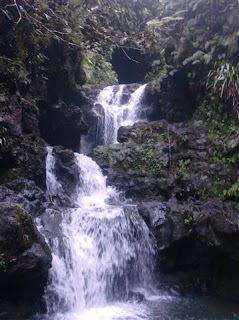
Monday, August 27, 2012

Coral Garden Photos (Taha'a)

Here is a string of underwater photos. I'll try to get around to identifying everything and come back and write the names in, but I figured I'd dump them on here since I have the photo compression software...

A trigger fish, a damsel fish, and a parrot fish...

Giant clams (Tridacna maxima)

Diadema (black spiny sea urchins)

More clams.


Sea cucumber of some sort.

Fire coral. 

Christmas-tree worm on coral. 

Saturday, August 25, 2012

Change afoot.


I motored over to Evergreen in the dink as they prepared to weigh anchor and sail to Bora Bora. We were in a small cove on the northwest side of Taha'a. The sky was overcast, matching the sentimental drear that seemed to be settling over the anchorages of the leeward islands as boats whose crews had only three months before been strangers were diverging out of French Polynesia. Heather had baked chocolate chip cookies to pass on to the crew of Ardea before Evergreen departed. We had planned to see each other in Bora, but after that nobody really knew. Even then, I had come to report our most recent change of plans.

Ardea at the quay.
After more than seven months living together on little Ardea, Taylor and I had to acknowledge that we were tired of one another. There's not much more to say about it. We needed a change- this boat is really small. I'm proud of what we did together and I know that without him as a co-conspirator, I may not be out here. Nevertheless, we agreed it would be best to make a change while our memories of the trip remained untarnished and our friendship remained strong. In the end, I would have a chance to satisfy my growing desire to single-hand a few thousand miles and Taylor and Anna would be able to make it to New Zealand and add to the coffers for a change. We poured rum and raised our glasses, a tension relieved at having made a decision on a matter of growing importance. The final days as a three-person crew were merry aboard Ardea and, in kind with our ways, we did not skimp on a celebratory drink accompanied by some animated reminiscing.

Taylor and Anna decided that they would be best off taking leave in Raiatea, just across the large lagoon from Taha'a. After touring about a shallow bit of motu-laden lagoon known as the 'coral garden', we motored back to the town quay in Uturoa, Raiatea. There the others set about making plans while I set about what would be a three day process of determining the problem with my electrical system; the alternator was failing to charge again, an issue that came to light (ha) after several overcast days when the solar panels couldn't keep up with our energy consumption. With the help of a Canadian expat who offers marine-related services to yachties passing through, I learned that the alternator's voltage regulator was burned out. He replaced it, but when I put the alternator back on and spun it up, I was still getting less than 12 volts. It was a frustrating time, already emotional because of the departure of my crew, made worse by the concurrent confinement to the quay. Long story short, the batteries were shot. I ended up replacing my two AGM house batteries with new slightly larger ones and getting a separate starter battery. The prices for the batteries, fortunately, weren't much higher than they would've been in the states. This was the right island at which to run into this problem, but it was an expensive start to single-handing no less.

When I finally got everything put together and got a reading of 14.2 volts off of the alternator, I happily moved from the quay and took a mooring ball on the northwest side of Raiatea. There, in the meantime, had gathered old friends Desolina, La Luz and Bombalero. I was excited to catch up with that crowd while enjoying a now remarkably ample power supply (it was pretty much revolutionary to get a battery bank that takes a charge consistently and an alternator that works!). With the latter two I went for dinner at Lisa K., a Tayana 55 from Fremont, CA. I had a great time meeting several new boats' worth of sailors and relaxing away the stress of costly boat repairs and lifestyle changes.

The next day I released the mooring ball with the main raised and sailed off wing-on-wing through the lagoon toward Taha'a. After six or seven miles of beautiful lagoon sailing, I furled the jib and rounded up to a south by southwest course to exit the pass on the southwest side of Taha'a. The waves were large because the swell and wind were blowing parallel with the pass, but, once on the ocean, I set the windvane and read my book as Ardea carried me on my first single-handed passage at a pleasant 5 knots toward Bora Bora.

Bora Bora is for many of the sailor contingent, the symbolic closing of the era that was French Polynesia. In three months in these islands, we had all seen and done more than we could possibly have imagined, and made lasting friendships in the meantime. Though many of us would carry on to the small island of Maupiti, still technically French Polynesia, after checking out in Bora Bora, this was the final hub that virtually all of the yachties would pass through and at which we would conduct our departure formalities. As I sailed the twenty-five miles from Taha'a, I thought back to our crossing from Mexico; it seems like a lifetime ago that we spent a month on this boat. It hardly seems real. Those four weeks from the middle of April to the middle of May seem almost a blank when the mind's eye glances back at them. Then the Marquesas and the Tuamotus and these Society Islands. There was good reason to be sentimental. We had been through a lot, we had learned, and we had looked out for one another. Though for more boats than my own the exit from FP represents a new chapter in this adventure, I'm happy to say that we survived this one and are the better for it. For my valiant crew members, I wish the most rewarding exploits with apologies for my imperfect command and the deepest thanks for their countless worthy contributions to the health of my ship and our crew.

Hiking in an unsuccessful search for the rare endemic
flower: Apetahi raiatensis.


Hiking Taha'a

Sunday, August 19, 2012

Don't tell anyone about Huahine.

Huahine

Time slows down when you're being eaten by water. I can get some real thinking done in just less than the time it takes to utilize all of the oxygen I can hold in my lungs at once. A wave picks up over the reef quite quickly and on my last glance back I can see the coral refracted in the rising transparent face; when I look forward again, I might make the take-off, even make a turn at the bottom and watch the coral heads fly by underneath me. More typically, though, in as fast a flash, I'll be eaten, sent into the guts and fumbled over the reef as though in a washing machine. It's then that I might muse about how remarkable it is that I don't actually touch the reef, despite being so entangled in churning salt water. It's really rather a peaceful time, at the mercy of the wave, patiently waiting for the water to lose its foamy state of agitation, when I can see the coral again and the little fish darting about the cavernous expanse and take a breath.

My introduction to reef breaks in Huahine brought a certain stout learning curve. The first difficulty was convincing myself to paddle into a wave even as the already shallow water beneath me surged out toward the coming swell, bringing me even closer to coral. Then there was the steepness and the quickness of the take-off. Basically all aspects of the shoulder-high left we were surfing pushed my mediocre-to-poor skills. I was not without commitment though, driven in part by the indefatigable enthusiasm of Michael. On Ardea's first morning anchored in the shallows of the crystal clear lagoon near the town of Fare, we made the long paddle out from Barfly at 0730 and were treated to beautiful conditions and only a few people at the break. I didn't make it back to the boat until a little after noon. Mike stayed even longer. The next day, we returned. The swell was a little bit smaller and not quite as consistent, so we surfed even longer, wary of diminishing opportunity. I had Mike and our new friend Juan giving me pointers and by the end, not without much folly, I was riding waves better than I ever had. The thrill of that gorgeous break, the warm water and the beautiful scenery around made it one of my most memorable experiences in the Society Islands.

Fare, Huahine.
Fare was a fantastic place to anchor. We had more than the swell. The town has a really nice grocery store and a couple of rolottos that sell steak frites until nine or ten and by far the best happy hour we've had in French Polynesia, but it maintains a certain mellow atmosphere that is really appealing. It is a gem in the Society Islands, which otherwise lack the slow old island vibe that brings the Marquesas happily to mind. When the swell departed, we split our time between spearfishing and terrestrial exploits. The two united merrily in the end.

A view from Fare.
Happy hour. Left to right: Mike, Matt, Taylor, Anna


First day's haul. A big-scale
soldierfish, threeTahitian soldierfish,
and a convict seargent.
Our first day with the spears in Huahine was a learning experience. Specifically, I learned that I am an inadequate free-diver. Matt, from Gypsy Blues, and Chittick discovered similar things regarding the quickness of fish and the abundance of coral caves. We had enough for at least a portion of our dinner, though.

Later that day, Chittick, Matt, Anna and I set out on foot for the town of Maeva, where there are some well-intact ma'rae sites- ma'rae are the now-antiquated alters and ceremonial sites made of coral and volcanic rock. We set out walking, but hung our thumbs out, sure to turn and face the cars as they came to pass, since one gets more rides that way. Matt and Taylor got picked up first. Anna and I shortly thereafter. Our ride dropped us right there at the ma'rae, which couldn't be missed from the road, but Chittick and Matt were nowhere to be found. Anna and I perused about, reading placards and snapping photos and considering but then deciding against participating in the tour slash museum portion, which costs 200 francs.

Marae at Maeva.
 
Traditional fish trap- the fish are hearded into the
wedge where they can be collected easily. Some of
these traps are still used.
The lagoon winds between Huahine iti and Huahini nui.
Hilltop marae.

Still no sign of the others, so we began wandering down the road away from where we'd begun. We came upon a bridge, at the base of which lay an upright stone with the words painted, “Galerie d'art & ice cream.” We had no allegiance to continuing on the main road and it was hot. So ice cream, in the end, led us across the bridge and eventually to Cesar's house. We first came upon Mel painting and she directed us towards the house, where Cesar, who goes by many names, would help us out with the ice cream. Asked what flavors, he said “Coco, Pistachio.” Asked which was better, he said, “Coco... Pistachio.” We both got a scoop of each and before too long found ourselves touring the house and making plans for a barbeque with Cesar the following day. We asked if we could bring our friends and promised to bring some food.

We decided to bring cookies and a salad but Matt, Chittick. Falcon and I wanted to see if we could spear some fish to barbeque as well. It took us about six man-hours to collect (read: barbarously impale) nine soldierfish. We were proud of our take. We scaled them near the beach on the quay with bottle caps. A Polynesian girl couldn't bare to watch and came over to show us how to properly clean them, cutting so that the gills and intestinal tract can be pulled out in one fell swoop. We soon set off, I carrying a mesh bag of fish and each with his own supply of beer.

Taylor wields spear.

Matt, Falcon and Anna cleaning soldierfish.
We arrived at Cesar's again in groups determined by hitch-hiking. Hours of joyful banter followed, including periodic subtle jokes about the size of our fish; everyone knows that to get bigger fish, including of the species we had targeted that day, one has to go to deeper water. So, it was slightly emasculating as it was so clear to all that we were only able to get the 10-to-15-feet fish. We were made to feel proud of what we accomplished, though, and were encouraged to mange our fish (“so that we could say that we ate it.”). It was a riotous affair, and we were lucky to have a ride back to the quay, for all of Huahine was asleep by the time we went home.

Some pictures from beneath the surface:


Tuesday, August 14, 2012

Gaggin' for a Chin Wag.

For some reason, I used to stay up really late basically ever night. Looking back on it, I'm not sure I ever really had any reason to do so. I usually go to sleep much earlier these days, but there's no obvious answer to the question, which I ask myself as I'm getting into my berth at ten or so, as to what on Earth I was going to do for another four hours when it's dark outside. Anyway, there are some clear contributors. Electricity is a precious and very limited commodity, bars don't really exist and most of the places we visit are themselves asleep not long after sundown. Better to go to sleep early as well, get up early and fully utilize the cool, pleasant mornings and all the sunlit hours left on this journey. It's pretty much the ubiquitous approach among cruisers and it matches with the islanders' lifestyle as well. I was surprised, though, at my internal reaction when the folks at the Gump Station, graduate students and their assistants, for the most part, told us to return for a party in a few days' time.

I asked what time we ought to show up. “Eight or nine,” said one. “Nine is probably better,” revised another. Right. Of course. That is really quite normal, early even, for those used to the patterns of home. It didn't matter, though. There's no sense denying, we were really stoked to hang out with these guys; a whole group of new people who do something other than peruse about on sailboats that want to sit around, drink, and speak English? We would've showed up at midnight if they'd told us to. We wouldn't be fashionable late though. No, we arrived mere minutes after the prescribed hour and sure enough the whole crew was still at dinner.

We were soon joined in festivities outside at the fare potee, which is a a roof of palm fronds supported by a frame that sits on eight or so wood columns arranged evenly about the space, which lacks walls and, as we were to learn, accommodates comfortably two picnic tables and a sandy dance floor. We stayed up way past our bed times. Past a number of our hosts' bedtimes as well. Thus the party was moved into one of the lab rooms, where we found ourselves dancing to music with a low blue lighting and occasional white strobes. The lighting was, of course, used for the numerous now empty aquariums in the room. The strobe was designed to simulate lightning. Fancy that. (It's science). I can certainly speak for the sailor contingent when I say it was a memorable night.

The next afternoon, just after I woke up, rain clouds began to form. At first, it was a sun shower (one of the best things). After a while, though, it became a cloud shower and the clouds were dark and ominous. The idea that the rain was light and would not affect our hike up the magnificent Mouputa (really, Mou'a puta), which was planned for the following day, was simultaneously conceived and subsequently abandoned, on Barfly, Evergreen, and Ardea. It happened over a couple of hours. The rain was very persistent. In the end we needed not even discuss it. We all knew: Barfly, Evergreen, Ardea. We would have to wait.

Sun shower.

Cloud shower.


We passed the next two days with plenty more football. Mike and I attempted a surf excursion, itching for some waves (Mike was having a recurring dream related to a lack of surf). We took a bus and wandered with our boards and got loads of information about where there existed good breaks. Here, though, with this swell direction, “no good,” complete with frowny face and thirty-degree head shakes. We paddled out to a pass anyway, just to check it out. It was too small to surf- little waves just tumbling over only the shallowest part of the reef- but it was nice to be in the water. Later that night, we were fortunate enough to catch Prinze and Douglas, old friends from my last stint in Mo'orea. We rounded off a solid day of wandering with a few hours of joyful chatter with those guys. It was a righteous, as the Scotsman would say, 'chin wag', meaning, naturally, conversation.

Finally it came time to make our attempt at Mouputa. We started out at 0600 and were on the trail, thanks to an unexpected and very convenient ride, at 0630. It was a very different trail than Rotui. There were trees and shrubs about creating a jungle atmosphere- and it was much more shaded. There were a number of steep parts with some sections where you had to more or less rely on ropes (in spite of our attempt at patience, it was still quite slippery), but it otherwise felt easier than Rotui. The views were amazing at the top and it was well worth the trek.


The namesake hole in the mountain.

Cook's Bay.

The ridge at the top. Didn't walk that bit.


Summit shot.


Barfly and Evergreen took off for Huahine later that evening. We resolved to follow suit the following afternoon. I headed back to the research station where I had a great time catching up with Frank and Hinano, the intrepid leaders of the lab. After, I caught up with the young ecologists down at the waterfront. It was inspiring to be among them and I resolved to soon do science once again.

We sailed for Huahine with fair winds and somewhat sloppy seas. It was a quick passage, overnight, eighteen hours or so total. We anchored again among friends off Fare, the largest town in Huahine. We had heard the holding at the anchorage wasn't great, so we timed our arrival with diminishing winds that would give us several days of peaceful weather at anchor. It just so happened, the swell was simultaneously wrapping around to just the right direction.

AMERICA! (But actually, Mo'orea)


Sunday, August 5, 2012

Where the roosters don't go.


There used to be a toy- maybe it's still around- that was a round plastic bit with a rotating arrow fixed to the middle. There were pictures of different animals around the perimeter. When the cord on the side was pulled, the arrow would spin and eventually fall upon one of the animals, at which point a speaker would play a recording of whatever noise that animal was liable to make. We learned our “moooo” and our “oink” and our “ baaahhhhh” and our “cockle-doodle-doo.” Something about the latter, though. Around the time this toy was a part of my life, I seem to have become accustomed to the notion that roosters crowed for the sake of waking up the farmer. If one kept a rooster, one could expect to know of the approach of the rising sun. I wasn't entirely misinformed. It seems, though, that roosters, at least in the South Pacific, warn one not just of an impending sunrise, but of the general and unending passage of time. They never stop. Eleven, twelve, one, two, three: rooster calls. It genuinely factors into discussions of various anchorages among fellow sailors; an anchorage might have poor holding, but if it lacks roosters, well then it's worth a gander. Unfortunately, in Mo'orea, the roosters are relentless, though we nonetheless remained anchored in Cook's Bay, altogether one of the greatest places on the planet, in my very biased opinion. It was over a period of several days, on a number of which I arose before sunrise, that I began to take seriously my observations of rooster behavior.

One evening as the sun was setting, the roosters called even as they ran headlong with panic into the bushes ahead of our waltz toward the Salle de Omnisports Paopao, where Michael, my Glasgowegian friend, and I had quickly become regulars for the nightly game of football (soccer). I noticed then that, strangely, the colorful birds never seemed to cut their calls off mid-way. Even as they sprang into the dense shrubs lining the road through Paopao, they finished with their “doodle-do” bit. Conveniently, though, and to my amusement, they announced our entrance to the building where we would meet with the local guys and await the conclusion of volleyball or whatever was going on. The following couple of hours were always grand. As in several other places in French Polynesia, we played five-on-five, first to score stays on, losing team goes off. Needless to say, if we ended up on the bad end of a short game, we were genuinely upset; maybe we were slightly histrionic, but if felt good to compete for a change. We would plop back down on the metal pipe that fits in a hole on the court to support a volleyball net when that's the activity in the omnisport and lament. Mike was usually pissed off- he would slide tackle a kid onto concrete if it meant staying on the court for another game. Who am I kidding, though- so would I.

That night we had played for hours and the local boys began to be quite fond of us, I think. They asked if we would come back again tomorrow (a demain, in French), but we told them it was unlikely, as we planned to climb Rotui. Most responded with a nod, saying, “Ahhhhhh, Rotui.” Some went on to warn us of treachery, but most just made sure we knew what we were in for and asked if we were going to come back for football after. To this I recall Mike, whose French is as poor as mine, responding that we would indeed return “a demain a demain” which means in two days if accompanied by an index finger arcing from one piece of air to another just farther along.

We had been on a good exercise binge, so we felt prepared to rise with the roosters, though they must never sleep, and set out on the intrepid hike. We got back to our boats from football well after dark. I ate dinner and opened my book, which Mike had come out against a few days prior, before I heard shouted from across the anchorage:

“Ay, you boys oughtta be gettin' to bed, eh?”

I sat in the cockpit reading One Hundred Years of Solitude under a flashlight.

“Well, man, I'm just too caught up in this book...”

“Oh, Christ. Well, we'll have to have a chat about it.”

“Yeah, well now I'm reading it with an eye to arguing with you.”

“Ha- right, well on ya go- we'll see ya in the mornin.”

Bright and early. And the roosters did crow, though it was well before sunrise.

I got up at 0500 so I could get some coffee and food in me before we headed out to meet with what had become a sizable expedition. Four boats represented- three people from Ardea, two from Barfly (Mike, the Scotsman with whom I'd shouted across the anchorage the night before, and Matthew, from London), two from Evergreen (John and Heather, from Vermont) and one from Vulcan Spirit (Richard, from London). We met at the dock at 0600 and set out to climb Mount Rotui, the peak separating the two great north-facing bays of Mo'orea: Cook's (Paopao) Bay and Opunaho Bay. We walked from our anchorage deep in the eastern Cook's Bay to the end of the peninsula dividing the two. There we began up the overgrown, indistinct, single-track trail to the ridge line, a veritable saddle, traversing its way toward the 900 meter summit. On the ridge we were highly exposed. Even with our early start, it was hot. Mike and I suffered from the proverbial foot in the mouth after having scoffed at the summit-post entry on Rotui warning to bring 6.5 liters of water per person. “Well, after reading that, we know to take everything else he says with a wee bit of salt,” was approximately what Mike had concluded while I rashly concurred as we were researching the hike. I had two liters of water myself; three would have been good, four plenty. In any case, the whole of our crew carried on like champions, remarkably chatty the whole way. The roosters stayed down at sea level; their calls carry better over water.


The path on the ridge was easy to follow, for to deviate more than a few feet in either direction meant tumbling down a steep facade. It was a four-limb hike in that one had to be able to use both hands to grab mats of ferns and small shrubs for balance. At times, the ground underfoot was sturdy; other times it was obscured by ferns and forbs, which created a springy, peet-like surface that often seemed a bit precarious. On one particularly steep section, we were excited to find some ropes strung along to provide some assistance. The ropes themselves seemed in good shape, though we didn't dare put too much weight on them. Good thing, too, for when we reached the far end of the first few lines, we noticed that there was for anchoring nothing but clods of fern roots. Alas, though, after about three hours, we made it to the top. The glorious views had us dangerously distracted the whole way up, but at the top they were all the more stunning. The weather, albeit hot, was perfect at the summit. We could see all of Mo'orea as well as the west coast of Tahiti in the distance. We stayed up there for a solid forty-five minutes munching snacks and indulging in conversation, which flowed easily in this group.


At the top [left to right]: Michael, Richard, Heather,
John (kneeling), Matthew, Me, Anna, Taylor


In fact, the level of chat was perhaps a bit too high as we began to meander back toward sea-level. It made for a bit of a distraction over portions of the ridge line that should have commanded all of our attention. I tramped downward engaged verbally basically at all times. Michael and I were discussing something certainly of questionable importance over one precarious portion when the mixture of fern roots and organic matter that made up the entirety of my footing gave out just as soon as my weight transferred to it. In an incredibly quick motion and without a sound, I flopped from the ridge and slid down about fifteen feet before stopping. Michael, probably wondering what happened to the sentence I had just cut off, turned to see me lying on a cushion of ferns and shrubs, saying only, “I'm down.” I was fine, though. Not a scratch. Really really dirty, but I had already been pretty dirty. I clambered my way back up to the “path,” now even more diminished, and we all sort of breathed that one in and had a laugh. It was lucky though, for sure, that I had fallen in a nice spot and nothing came of it. We all resolved to concentrate more on getting down safely so we could continue our endless banter with crew intact.

John and Heather on one of many false peaks.


Michael and Matthew scampering.

Richard on one of the more treacherous reaches/

Before too long, we had all made it down safely, if a bit dehydrated. We sauntered back toward the anchorage and drank cold juice and water and beer. It was grueling, but well worth the effort. We ate heartily that evening and made it an early night, though only after Mike, Taylor and Anna joined me out under the old fare pote'e at the Gump Research Station to hang with a few old friends and some new ones. Later we walked back to the dinghy dock with dragging feet and heavy eyelids. I soon fell into a deep slumber in spite of the garrulous poultry crowing on through the night.

Opunaho Bay.

Mo'orea with Tahiti in the background.


Opunaho Bay and the Pacific beyond.

Cook's Bay (our boats are down there somewhere).

More Opunaho Bay.

Tuesday, July 31, 2012

A Melancholy Ink.


Approaching Tahiti- Point Venus just visible, where
Capt. Cook made his famous observations of the
transit of Venus.
Papeete Harbor. Busy.

Entering the pass into Papeete Harbor we passed to port some surfers riding little waves at the end of the jetty, just inside the (red!) channel marker. We passed commercial shipping vessels, hotels, and waterfront parks chock full of busy-looking people and romantic-looking people and people jogging for fitness. Countless outrigger canoes glided silently past. We made way for the yacht quay where we would tie up in downtown Papeete. Looking astern, the sun fell slowly toward Mo'orea twenty-five miles west and I could feel in my chest the allure of Tahiti. The site of her invoked the sense of that satisfying, indulgent refreshment one gets from the first sip of a frosty beer after a long day on the water. Exactly what I needed. Tahiti. Right down the gullet.

The Pacific had belted us for two days with southeast trade winds reinforced by a strong high pressure system (anticyclones in the southern hemisphere) to the South- the squash zone, as it's known- and a mixture of swell directions as thoroughly diverse as the campaign ads surely being distributed well at home these days. It was an onerous, if short passage, though Ardea herself didn't seem to notice. Her captain, though, licked by a bit of treachery from the sea, couldn't help but ponder the various virtues of a terrestrial lifestyle...

(I wonder what they did during the howling winds and sloshing seas? Maybe they went to a movie theater, or a restaurant, or maybe a bar. Maybe they just slept and didn't even notice it going on. It accentuates in my mind the notion of having become alien to urban, the thought that people here were dancing in nightclubs the night before while I, just a hundred miles away, clung to the steering wheel soaking wet in my boxer shorts in pitch dark composing a symphony of curse words and other angry sounds and trying to keep the boat pointed down the waves.)

Taking in the surrounding city, I felt duly out of touch with this type of life. I wondered if a month at sea followed by two in some of the most remote places in the world had begun to construct barriers to communication beyond that of language, for what else did I have to talk about but the wind and the clouds, the currents and the swell and little bits of rock cropped up in the middle of the Pacific providing refuge and small, welcoming communities? I wasn't feeling cynical. No, it was that I felt a misfit among the landlubbers whose daily activities and suite of decisions, risks and consequences were so dissimilar to what mine had now been for six months. It was a strange feeling to be back in a city, but don't doubt that we were entranced and delighted and drawn powerfully by the madness we observed from the quay.

Cars buzzed by, neon lights shone on hotels and restaurants, people were all over the place, hustling and bustling and all that city stuff. It had been so long. We settled in and caught up with Slick and Desolina, docked nearby. We washed and drank from the dockside spigot and wandered through Papeete proper. The spiteful seas of our passage from Faka Rava and the lengthy isolation from any sort of population center gave this city a brilliant novelty in our eyes. I, for one, was more appreciative of the city life than I had been for a long time. The variety of choice was tantalizing. In spite of a greater anonymity than I'd experienced in three months, I felt shy, a bit withdrawn. Still, I was tickled by the sight of so many people and so much activity.

We wasted little time in exploring the modern delights of an international metropolis, our energy renewed by quixotic pleasure. We ate hamburgers at a restaurant and finally drank a bit of ale; the mediocrity of the food and the expense of the beer were well mitigated by the ironic feeling of serenity in the ant farm of humanity. The boat secured in safe harbor, the ground solid beneath our feet, only a bit of automobile traffic and the occasional ruffian to worry about, the guard could be dropped a little, for a while at least.

We should have been exhausted, but Dana and I wandered the many wharfs of Papeete Harbor late that night. A downpour kept us beneath a tree for a time, waiting patiently; we could have remarked at how easily it came, this patience, that it wasn't irksome to slow or be slowed, that we'd changed a bit in our pace and perception. Released by the passed front, we walked over damp asphalt and swung open the creaky gate to a long quay lit by a row of orange lights where there was tied a ketch of at least a hundred feet in length. We meandered along staring at the vessel. The turnbuckles seemed as big as I, the masts far too wide to be wrapped by my wingspan. There were at least three large tenders about. We stared a bit in awe at the magnitude of the ship, contemplating the juxtaposition of equipment and experience. All I could think to say to Dana was, “Well- we came to the South Pacific on a ketch, too.”

We walked slowly away pretty sure we preferred the immersion of our experience, the mental impacts of a gnarly two days' passage already fleeting. We went to the food trucks, still open at midnight, and had second dinner. It was amazing, phenomenal in fact, to have this option, but we were quite sure that the seductive powers of well-developed civilization would soon wear away.

For several days in Papeete we remained entranced and intrigued. We visited the huge market where everything from trinkets to parrotfish are available for purchase and enjoyed cheaper beer from ample well-stocked grocery stores. We settled in on the quay and made friends with some new folks, Michael, a Scotsman on a boat called Barfly, and Troy, an Aussie on a boat called Yameja, both hilarious dudes of the best possible sort, with whom I would find myself spending a good deal of time in coming weeks. Mike, whose well-projected, ceaseless voice seems to rub its accent off on everyone, left Glasgow two years ago and has since crewed on five different boats en route to a piecemeal circumnavigation while surfing every wave he can find. Troy is making his way back home over the big blue crewing on a catamaran. Both had skippers away for a month and were meant to watch their vessels and enjoy Tahiti in the meantime. This we all did, with plenty of beer-fueled banter in the spacious aft gallery of Yameja.

It wasn't all beer and steak frites, though. Actually, we began a continuing stint of high activity there in Tahiti. The crew of Ardea made the grueling hike to the lava tubes, which were fascinating bits of geological history. We managed to find our way to the local soccer pitch- fittingly a fine artificial turf field complete with cork track just outside of the downtown area- for a couple of evening games. Dana and I accompanied Mike on the bus to Papenoo, one of the few beach breaks around, and caught some of the fabled Tahitian waves (ok, well, Teahupoo is fabled, and there are other insane reef breaks as well, but Papenoo is on a whole different, much lesser, level).

First lava tube.
Clambering between lava tubes.

The second lava tube atop the falls.
Clambering down from the second tube.

We stayed in town long enough to pick up Anna, who came to join the boat for a while, but by then the charms had mostly diminished. I noticed I was sensitive to the more polluted air, the lights and the general indifference among city peoples. It was noisy, too. Traffic was unending and passed just near the quay. That alone wasn't terrible to sleep through, but one night after a rain the roller for the ramp on the next dock over began to squeak a loud, high-pitched whine. It was irritating to me, so at 0230 I walked off the dock, down the waterfront a bit, and climbed over the fence to the offending bearings. I went to town with my bottle of WD40 and shut the thing up, longing already for the quiet of a secluded bay with stars unencumbered by city lights, the distant drone of the breakers over the reef and the lapping ripples on the hull the only persistent sounds.

Soon we planned to make the short crossing to Mo'orea, only about 25 miles. Dana would be flying home soon for good and I would be leaving for a hiatus to join my family for my grandparents' fiftieth wedding anniversary, so I wished to get Ardea to Cook's Bay where she would be safe and where Dana could get a last taste of the majesty of the South Pacific. He and I wanted to catch a few more waves in Tahiti, though, so we left early to get the bus to Papenoo for a morning session before departing to Mo'orea in the afternoon. Little did we know, the bus was not running, as it was some holiday, and we found ourselves sauntering through Papeete in the general direction of Papenoo. We had only what would have been bus fare and our surfboards. We spent the former on beer and a baguette and wandered merrily, making conversation with numerous characters attracted to the comical scene of a couple of Californians with surfboards who seem to have entirely lost the direction of the beach. It was an enjoyable meander, an appreciated look at the outer parts of Papeete and a slow brew in the subtle differences between this place and those we'd prior seen.

The jaunt to Mo'orea was windless. We motored the whole way, stopping for a time off of the northwest coast of our destination to splash and swim in the deep blue yonder. Pulling into Cook's Bay was for me an emotional experience, full of nostalgia and a deep satisfaction; I had studied at the Gump Research Station, a UC Berkeley field lab, for ten weeks in 2009, and knew and deeply loved the place. To putt past the old digs on my own vessel three years later represented something of significance for me, and I gazed almost in disbelief at the familiar and breathtaking landscape after we set the hook deep in the bay.

We made the usual rounds to friends' boats to catch up as the sun was setting. Soon after, the sound of music carried across the water to our ears, finding us want of a scene to explore. We went ashore and followed the tunes to a nearby lot where loads of people played bocce and celebrated life. It was only local Polynesians about, so we quickly attracted attention and found ourselves awash with conversation and hilarity. A large red canopy in the corner housed the band- drums, ukuleles and guitars- as well as a counter behind which a small crew prepared food, sold beer and organized the bocce tournament. We ate and drank and chatted about while local men, plainly drunk, played the best bocce I've ever seen. Dana, recalling our experience on Tahuata with Jimi and John, motioned toward one particular game after a ball came to a halt just next to the target, saying to a new Tahitian friend nearby, “Attack,” except with the proper accent making it sound more like “Ah-toc.” Thus began several minutes of uproarious laughter as the local guy went about telling his friends how the American guy, who speaks no French, knows “attack” as relates to the game.

Some time shortly thereafter, Dana learned that in that there tournament, the top prize was no less than a 20 kilo calf, fully butchered. He quickly decided to enter for a thousand francs and try his luck; I became his teammate, so it became our luck. We would need it. Dana told the woman behind the counter under the canopy that he would like to enter the tournament and presented her with the appropriate currency. After a few minutes of her trying to persuade Dana that his entry was a waste and that he might find a non-monetary game in the early afternoon on the following day, she accepted his money and wrote down his name on the bracket. It should be noted that Dana, as so many of us, alters the name he gives people slightly in order to assimilate the sound with whatever language is spoken. In Mexico, Dana was Dan, I was Con-Nore, and Taylor was Tay-Lore. In French Polynesia, Dana is Don, I am Connair, and Taylor is pretty well understood.

Don and I showed up to our first match and our opponents greeted us, shook our hands, stood back and gave us a quizzical look. Obviously we hadn't realized that it was BYOB. We had beer, but we were forced to delay the game until the neighboring match finished, so we could borrow someone's balls. The nice lady behind the counter, who spoke quite good English, coordinated the loan for us after Don approached her regarding the embarrassing lack of balls. Once equipped, we began what would be possibly the most uninspired and brief games ever played on the island of Mo'orea. Don and I were caught off guard. It happened so fast. We played to seven, lost in two rounds, the minimum possible. It's redundant to point it out, but we did not score any points. They barely even needed to attack.

We sauntered for a minute or two after our opponents laughed and thanked us and walked away. The woman from behind the counter saw me. I told her we lost. She picked up the microphone and the loudspeaker blared, “Don, you have lost. Please return all the balls. Very embarrassing.” And so another bout of laughter focused our way as our short careers in competitive Polynesian bocce came to an end. Perhaps our real problem was in treating it just like bocce. Really, they call it petanque, and the balls are slightly smaller and made of metal. In fact, it's starting to seem like a cut and dry case of equipment-based disadvantage. Trade for some ceramic balls of increased diameter and we'll see who's attacking.

Obviously we considered entering a one thousand franc cash side bracket, but, in the end, we figured all the sport was cutting into our time with beer and new friends. So we partied on in fine fashion well into the night, as it was Dana's last and there remained many Hinanos to hold in toast to such a fine seaman. Surely the following morning was imbued with a melancholy ink.

Dana and I took the ferry back to Papeete and celebrated the many thousands of miles of ocean we had together traveled over beers with Troy and Mike. We were, in the end, happy to have experienced what trying weather we had on the California coast and finally again en route to Tahiti. We survived and kept the boat safe and now we sat in one of the most captivating places in the world having accomplished something that only just a few years before had seemed an improbable dream. Though I was on all too many occasions a cantankerous captain, I couldn't in retrospect make any complaint about Dana's fine service on Ardea. To be sure, while he began as a novice crewman, he departed among the ranks of capable offshore sailors, a proud accomplishment. Dana took off late that night and made it home some twenty-four hours later, albeit with staph infections on both feet from festering tropical wounds (reportedly healed). I left a day later, excited to see my family for an intermission, wondering about the new chapter of this journey to follow.

Monday, July 16, 2012

On to Tahiti

            Perhaps we should have realized what we were getting ourselves into from the moment we left the south pass. The East by Southeast wind, the beginning of an ebb tide and the narrow pass combined perfectly for some incredibly large, choppy, stomach-turning waves that we had no choice but to take right on the bow. Although we were pounding the boat through something that I imagine to be like the North Atlantic (only a little warmer) we were making very little headway out of the pass.  We soon discovered that the weather stripping had failed on the front hatch and the entire V-berth was completely drenched and would remain that way for the entire passage. After a couple hours of beating South away from Faka Rava we were finally able to turn to the West, right around sunset, and assume our course for Tahiti.

We were still under a reefed jib, doing around 6.5 knots, and the motion had eased up, but was still nowhere near comfortable. The first night was a little rough. The large high-pressure system we were trying to avoid had not quite settled in yet so the winds were still moderate, but the swell coming from three different directions as well as the soaked V-berth made for a rather sleepless night. We eventually took to just sleeping on the floor as it was impossible to stay in the windward berth, especially when the occasional Southerly swell came right on the beam and threw us across the cabin.

            Needless to say we were all a little pissed off the next day. Nerves were running high and every one was doing there best to stay out of each others way. We attempted to fall into our usual passage habits of reading and relaxing but the uneasy weather, the lack of sleep and the anticipation of getting to Tahiti were making it difficult.  The three-direction swell continued and the winds were slowly increasing but we figured that we had put enough distance between us and the high pressure system that we would hopefully avoid the worst of it. Sunset came and went and we were still under a reefed jib with our only consolation being that we were just over 70 miles from Tahiti. After another substandard dinner of overcooked noodles I went to bed early in anticipation of my last, hopefully uneventful, late night watch on Ardea.

            Just before 2 am, after no sleep, I got the call to get up. Nights on Ardea always struck me as sort of bizarre. Often in a half dazed state, one always wakes up to the night lights of the nav station, which cast a dull red-orange glow over everything and always cause me to question, if only for a split second, whether this is just some messed up dream. The winds were noticeably heavier but not much more than 20 knots. I helped Taylor jibe as the winds had clocked around to the North and were causing us to point well below our destination of Papeete on the Northwest side of Tahiti. With Ardea on course once again, Chittick went to bed and I remained sitting at the nav station trying to pass the time for the next three hours. Reading was impossible and besides going up to the cockpit every 20 minutes or so adjust the wheel, I just sat and contemplated the end of my trip. I would be flying home from Tahiti so this was a farewell of sorts for me; my last night watch on my last passage aboard Ardea. Being on the boat for so long had caused me to be very comfortable with my own thoughts; I could spend hours in my own head oblivious to the outside world.  I got caught so deep in thought that only the heel of the boat from a big gust of wind was enough to cause me to snap out of it and go check on the boat. 

            The puffs of wind had been pretty heavy, but this one was different. You could feel it almost immediately. The boat pointed up into the wind and we heeled over more than we had all night. “Connor get up, we have to reef again,” I yelled from the companionway. Needless to say he was not overly enthusiastic. “How much jib do we have out,” was his reply. “Just get up I need your help.” Even after months at sea I still would not consider myself an “expert” sailor and I knew that this weather was like nothing I had ever dealt with before. I think Connor could sense the urgency in my voice and we both piled out of the cabin with no time for life jackets or harnesses. I knew that this was the most wind we had experienced on the entire trip but with the urgent tasks at hand I didn’t really recognize the magnitude of the situation.

We were in a full Gale. There was no time to waste, and both of us went to work reefing. I was disoriented and slightly panicked and Connor didn’t mince any words in telling me to get the boat off of the death angle and point downwind. In the confusion I accidently jibed, to which Connor, in so many words, screamed at me to figure out what exactly I was doing. We eventually got everything settled, and with only a handkerchief of jib out, I still had to hand steer as the 40-50 knots of wind was way too much for our windvane to handle. We finally had time to harness in and the full scale of the situation was realized by us both. The gale blew itself out over the next hour and Connor assumed steering duty from me as my watch ended. I went down below and attempted to sleep. Suddenly a conversation from earlier in the day popped into my head. Chittick and I had been reminiscing about the trip, and I told him how I was pretty bummed that we had had such light wind the whole time. I remembered telling him how I hadn’t had any Hollywood moments, where I thought I was going to die, and I had wished for just one gale so I could know what it felt like. Upon remembering this conversation, I smiled at the way things work out sometimes.

The gale blew itself out and by the time I emerged the next morning the seas and wind were surprisingly calm. Everyone was in a foul mood after not having slept for two days and not much was said between us as we were all just hoping to get to Tahiti and have a cold beer or two. The wind died down so much that all the sails were hoisted and we were still in danger of not making it to Papeete in the daylight; which would mean another night out at sea. I relieved the autopilot of her duty and hand steered for most of the afternoon as I knew that this might be my last chance to sail a boat for a while. We eventually started to motor as the wind died down even more and we pulled into the main pass of Papeete as the sun sat low in the sky over Moorea, 20 miles to the west. We were unsure of where we to anchor and headed towards downtown and the main ferry terminal. It turned out that there were a few nice docks, located right off of the main road, and since many of the boats had gone over to Moorea for the puddle jump rendezvous, there was plenty of space to pull in Ardea, bow first, right up to the dock. We had made it, the sun was setting and we were in downtown Papeete, the first city we had seen since Puerto Vallarta, two months prior.